Looking for the perfect gift? Wondering what kind of book to get for your friend/sibling/niece and nephew/parent/grandchild? Are you hoping to receive books as gifts? Our staff are readers and gift givers just like you AND we have the advantage of being surrounded by books daily. Here, on the cusp of the holiday season, we give you a brief rundown of books that our staff recommend for both giving and receiving.
We’re nearing the end of our year-long Bookworm Challenge and November feels like the start of the home stretch. It’s time make a full throttle, wide open sprint towards the finish line. Nonfiction is the genre, giving you permission to pick anything to read, so long as it’s true. Cookbooks? Yes! True Crime? Of course! Decorating? Yep. Crafting? Sure. Rembrandt? Absolutely!
Creating a recommended reading list for nonfiction would be counterproductive since nonfiction is such a broad vista. If you know what topic you’re interested in, you can always search the catalog to find it. But what if you prefer to choose books by browsing around the shelves? For you browsers, lets acclimate you to the shelving system. Then, you can wander through the stacks but not wander aimlessly.
If you still remember the Dewey Decimal system from grade school or if you’re a frequent visitor to these shelves, you probably don’t need to read the rest of this post. Go wild and find your next read for Nonfiction November! If you don’t know the shelving system and don’t know where to start, keep reading.
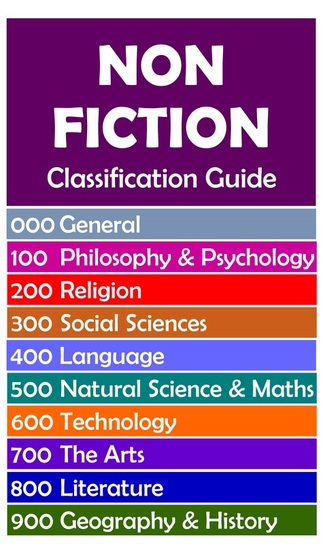
First, all non-fiction is shelved by assigning broad topics to a numerical range from 0 to 900. This classification guide at right shows the ten classification categories. Inside a sequence, similar subtopics are shelved together, using more decimals and letters as you get more specific.
Let’s look at history as an example. History and Geography are all assigned within the 900-999.99 numerical sequence. Any true (nonfiction) book about historical topics will be shelved inside these numbers. Within the 900 sequence, you find subdivisions like geography and travel (910), biographies (920), European history (940), etc. The chart below, from the website LibraryThing, gives you an easy visual representation of this breakdown.
So if I were looking for a book about the American Civil War, I am able to browse everything our library has about the war in the 970-979 sequence. If I wanted to read about Chinese history, I would browse through the 950-959 sequence. Is it making sense yet?
We have some handy charts inside the library to remind you how the classification system works. If you’re a browser, don’t be discouraged. Reference the chart, look up a keyword in the catalog for a starting point, or ask one of our friendly library staff, “Where can I find books about whales?” Whichever way you use, with the broad shelves of nonfiction to choose from, you’ll have no trouble finding something that interests you.
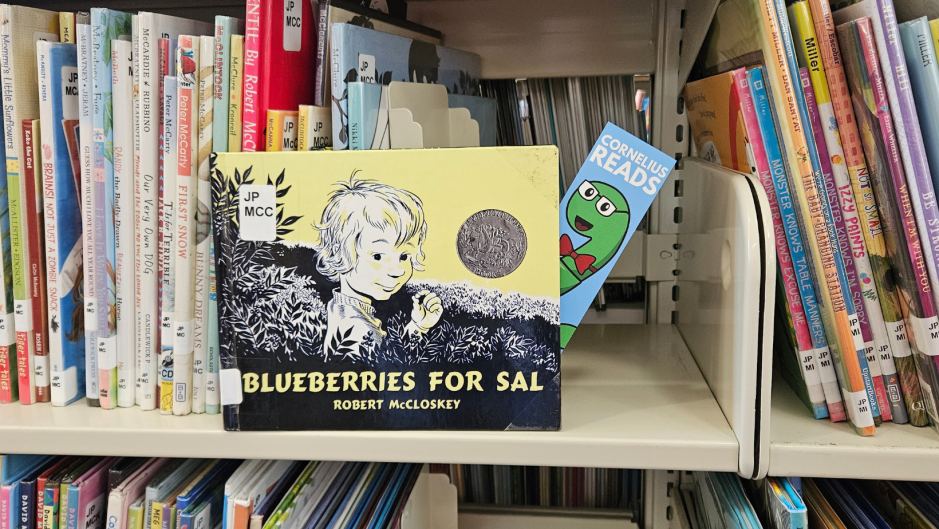
Robert McCloskey’s Blueberries for Sal, published in 1948, is a well-known and timeless children’s classic. Annie in Youth Services warmly recommends this beloved book, in time for the local blueberry-picking season.
A peaceful poetry collection is this month’s recommendation from Annie in Youth Services. Devotions is a carefully curated selection of poems by Mary Oliver about nature, contemplations, and life.
Annie from Youth Services is recommending the thoughtful and inspirational picture book Something, Someday by Amanda Gorman. Keep reading to hear more about this wonderful children’s book perfect for summer!
If you’re looking for a funny picture book, Hayley from Youth Services has an awesome recommendation: Chez Bob by Bob Shea! Keep reading to learn more about it.
Kicking off our first book recommendation of 2024 is Cindy from Tech Services with the high fantasy recommendation Anything with Nothing, edited by Mercedes Lackey. Read all about it in this post!
Happy holidays, all! Brittany from Youth Services is recommending How Does Santa Go Down the Chimney?, a picture book written by Mac Barnett and illustrated by Jon Klassen. Read all about it in today’s blog post.
Everything Sad is Untrue is Daniel Nayeri’s middle grade novel debut, and it’s a book that Katie from Youth Services is recommending you read. Is everything sad untrue? Keep reading to find out!
This month’s book recommendation is courtesy of Angela from Adult Services, who is suggesting the adult fiction novel Sankofa by Chibundu Onuzo. Keep reading to hear Angela’s thoughts and insights on this book.




 Sincerely, Cornelius